When you order a circuit from Lumen, Zayo, Cogent or any other carrier, the price, install date and who fixes it when it breaks usually come down to one thing: who provides the last stretch of fiber into your building.
The four terms you will see on most carrier quotes describe that from different angles. LEC is a kind of company. Last mile is a segment of the network. On-net and off-net describe whose network the circuit actually rides. Once you can place each one on a map of the circuit, quotes become much easier to compare.
The four terms, plainly
LEC (Local Exchange Carrier) is a company that provides local access network service in an area. There are two kinds:
- ILEC (incumbent): the original local phone company in a region, such as AT&T, Verizon (which now includes Frontier) or Lumen in its legacy CenturyLink/Qwest territory. It owns the central offices and much of the local copper and fiber in its region, though it doesn’t necessarily have fiber into every building.
- CLEC (competitive): a newer entrant that built its own local network or leases parts of the ILEC’s.
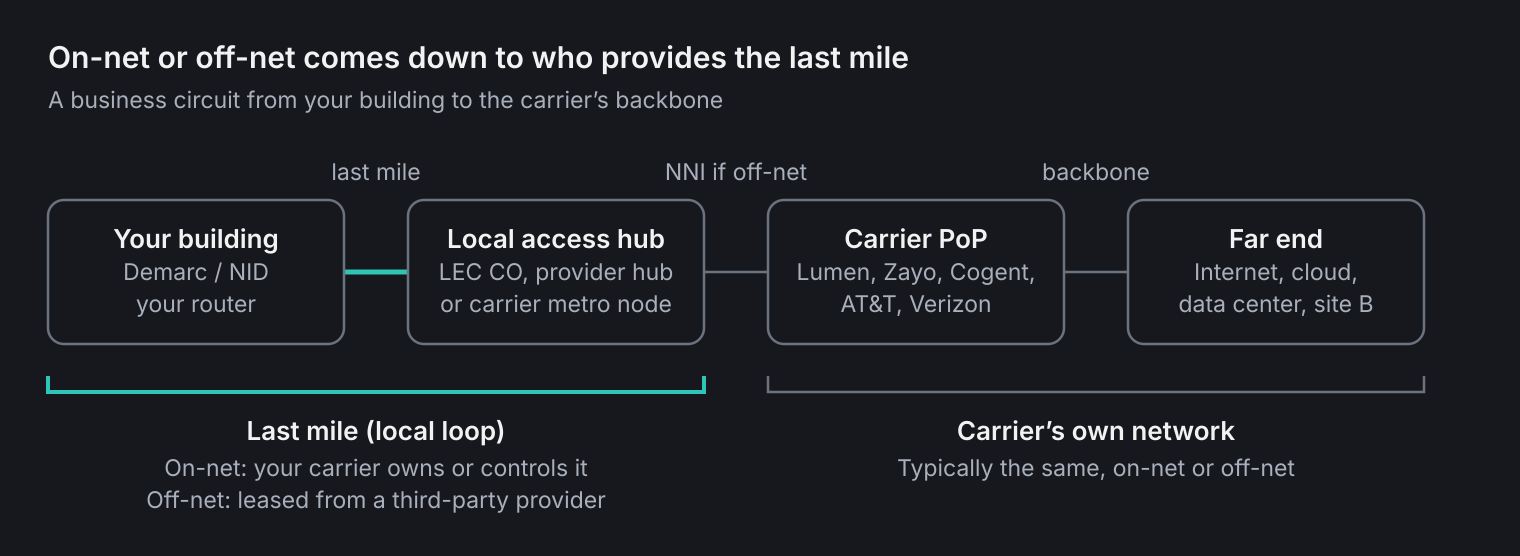
Last mile (also local loop or local access) is the physical link from a carrier’s nearest point of presence to your building’s demarc. It’s usually the most expensive part of a circuit to build because it can mean trenching, permits and building entry. It doesn’t have to be a mile long.
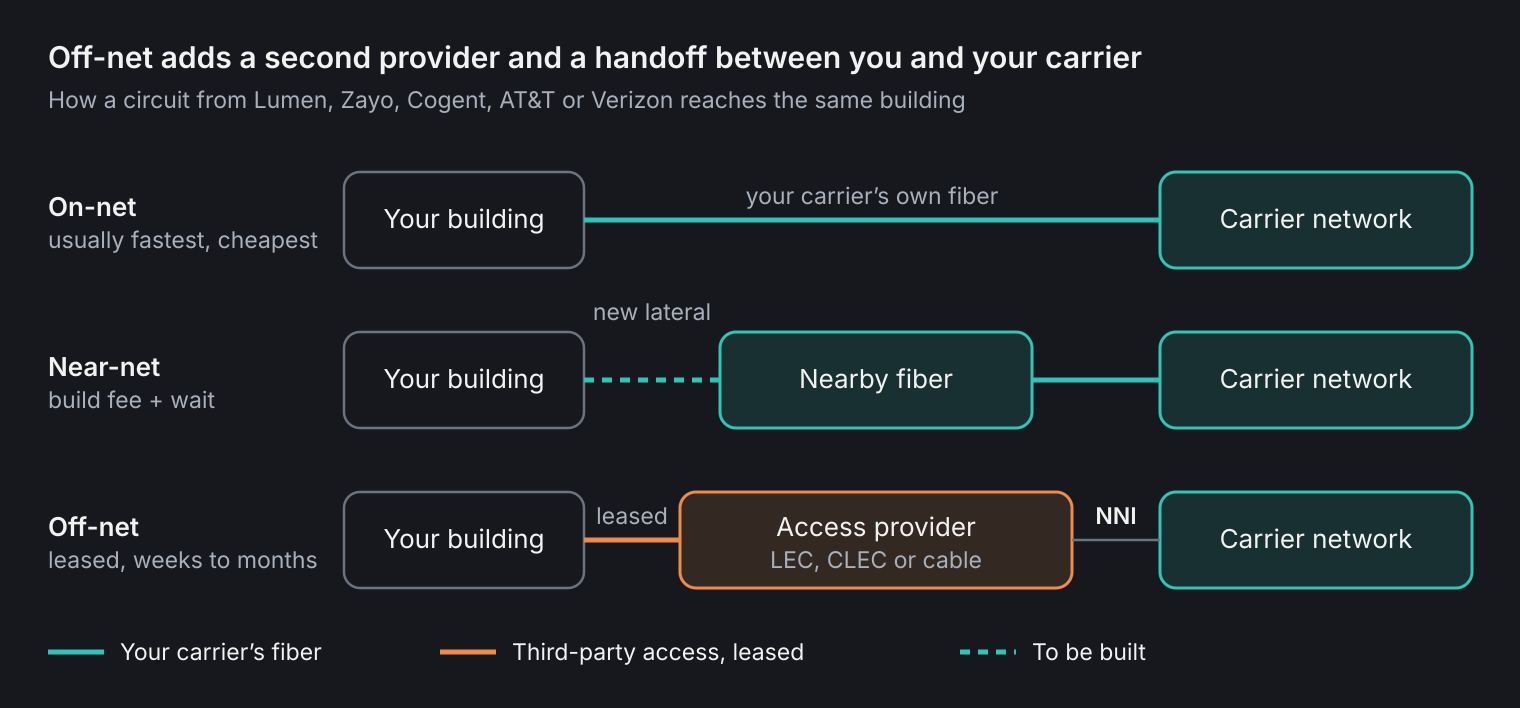
On-net means your carrier’s own network already reaches your building and is lit there. The carrier controls and operates the whole path, but it doesn’t necessarily own every strand of it. Some segments may run on fiber it leases long term or holds under an IRU (indefeasible right of use).
Off-net means your carrier has no facilities there. It buys the last mile from a third-party access provider and hands it off to its own network at an NNI (network-to-network interface). That provider is often the local ILEC, but it can also be a CLEC, a cable operator or another wholesale fiber company.
Near-net sits in between: the carrier’s fiber runs close by, and it can build a short lateral to bring your building on-net, usually for a construction fee or a longer term.
Where each piece sits
In a typical facilities-based carrier service, the carrier’s backbone stays the same whether the last mile is delivered on-net or off-net. What differs is who provides the highlighted last mile, and where the two networks hand off (the NNI).
Three ways a carrier reaches your building
On-net means one carrier operates the path end to end. Near-net needs a short build first. Off-net puts a third-party access provider, often the LEC, between you and your carrier. The handoff at the NNI typically adds cost, time and a second party to every trouble ticket.
How it plays out with Lumen, Zayo, Cogent, AT&T, Verizon and others
Every carrier is on-net in some buildings and off-net in many others. What changes from one carrier to the next is where its fiber reaches. You can’t tell from the brand alone, so check each address.
- Lumen is both a national backbone carrier and an ILEC in its legacy CenturyLink/Qwest regions. In those regions it may own the last mile itself. Elsewhere it often buys access from the local ILEC or a CLEC. Lumen sold its consumer fiber business to AT&T on February 2, 2026 but kept its national, metro and enterprise fiber and its central offices (Business Wire).
- Zayo is a fiber-only infrastructure carrier with dense metro networks and extensive data-center reach. Its purchase of Crown Castle’s fiber business closed on May 1, 2026, adding about 90,000 route miles and 40,000 on-net enterprise locations. Many buildings that used to be off-net for Zayo may now be on-net (Fierce Network).
- Cogent is known for low-cost dedicated internet access (DIA) in on-net multi-tenant office buildings and data centers. Outside that footprint, its service is usually delivered off-net over a partner’s last mile.
- AT&T is the ILEC across much of the South, Midwest, Texas and California, so inside that region it often owns the last mile. Outside it, AT&T buys access like anyone else. It added Lumen’s consumer fiber in eleven states in February 2026. That network is mostly residential, but it extends AT&T’s local fiber in those metros. Its wholesale arm also sells last-mile access to other carriers, so an off-net Lumen or Cogent circuit may actually ride AT&T fiber.
- Verizon is the ILEC in the Northeast and Mid-Atlantic (the Fios footprint). Its purchase of Frontier closed on January 20, 2026, so Frontier’s ILEC territory is now part of Verizon. Verizon says the combined network reaches 31 states plus D.C. (Verizon 8-K). Verizon Partner Solutions, its wholesale arm, is a common off-net access provider for other carriers in those areas.
- Other ILECs, CLECs and cable operators (Windstream, Consolidated, regional fiber companies, Comcast Business, Spectrum and others) own last-mile facilities in their own regions. They often appear as the access provider on off-net orders.
- Aggregators and resellers generally don’t own a last mile. They buy on-net or off-net service from the carriers above and resell it, which adds another layer between you and the fiber.
One address can be on-net for Zayo, near-net for Lumen and off-net for Cogent. Get a quote from each carrier, because pricing varies widely even among on-net options.
On-net vs. near-net vs. off-net at a glance
On-net is usually cheaper and faster to provision, and off-net usually slower and more expensive, but there are exceptions. The install intervals below are illustrative, not industry benchmarks. An off-net circuit over existing facilities can be delivered faster than a near-net circuit that needs construction and permits.
| Factor | On-net | Near-net | Off-net |
|---|---|---|---|
| Who provides the last mile | Your carrier (owned, long-term leased or IRU) | Your carrier, once the lateral is built | A third-party access provider, often the LEC |
| Price | Usually lowest | Middle, plus possible build fee | Usually highest (access cost + markup); wholesale deals can narrow the gap |
| Typical install | Days to several weeks | Several weeks to several months, depending on construction | Several weeks to several months, depending on access-provider availability |
| Support | One carrier operates the path | One carrier, after the build | Two or more parties; faults can bounce across the NNI |
| Route diversity | Must be verified; the carrier can document its own route | Must be verified after the build | Must be verified and harder to confirm; the access route may be shared with your other circuit |
| Upgrades | Often a config change, if the port and optics allow | Same as on-net, after the build | May require a new access order |
Carrier diversity does not guarantee physical diversity. Buying circuits from two different carriers doesn’t necessarily give you two independent physical paths. Both carriers may buy access from the same local provider, run through the same conduit, enter the building through the same MPOE or cross shared aggregation infrastructure.
True redundancy means identifying and validating shared-risk infrastructure, not just buying circuits from different providers.
More terms you’ll see on quotes
These show up on quotes, order forms and install emails. The building and handoff terms matter most, because install delays usually start there.
Building and handoff
| Term | What it means | Why it matters when ordering |
|---|---|---|
| Demarc (demarcation point) | Where the carrier’s responsibility ends, often in the building’s main telecom room | Anything past it is yours to wire, or to pay someone to extend |
| MPOE / building entrance | Minimum point of entry: where outside fiber enters the building | Two circuits through one entrance aren’t truly diverse |
| Extended demarc / inside wiring | Cabling from the demarc up to your suite or rack | Often left out of quotes and can delay turn-up by weeks |
| NID / NTE | Network interface device / network termination equipment: the carrier device that commonly marks the service demarcation | Its port type and optics (copper, SFP, 1G/10G) must match your gear |
| CPE | Customer premises equipment: a broader term for gear at your site, such as routers, switches and firewalls | Clarify which CPE the carrier supplies and manages, and which is yours |
| UNI | User-network interface: the port the carrier hands you | Specify speed, optic type and whether it’s tagged or untagged |
| Meet-me room (MMR) | The room in a data center or carrier hotel where carriers interconnect | Where your circuit actually reaches the carrier in a data center |
| Cross-connect | A cable between your cage and a carrier’s in a data center | Ordered and billed by the data center, separately from the circuit |
| LOA / CFA | Letter of authorization / connecting facility assignment: the exact port to land on | Data-center installs stall until it’s provided |
Access network and diversity
| Term | What it means | Why it matters when ordering |
|---|---|---|
| PoP | Point of presence: a carrier site with its routers and switches | Distance from your site to the nearest PoP drives access cost |
| Central office (CO) / wire center | The LEC building that serves an area’s last-mile lines | Off-net access is often priced by the CO that serves your address |
| Lateral | A short fiber build from a carrier’s route into a building | It’s what a near-net build fee pays for |
| IRU | Indefeasible right of use: a long-term right to use fiber someone else owns | An “on-net” path may include IRU segments the carrier controls but doesn’t own |
| Type I / Type II | Common shorthand: Type I = the carrier’s own facilities; Type II = access leased from another provider. Definitions vary by carrier and product catalog | Confirm the actual underlying facilities, whatever the label |
| ENNI | External network-to-network interface: an Ethernet interconnection between two network operators | Confirm service mappings, VLAN tagging, MTU and handoff requirements between providers. VLAN IDs don’t have to match end to end, since carriers can translate or stack them (QinQ) |
| Route / path diversity | Circuits that share no conduit, building entrance, CO, aggregation equipment, bridge or rail crossing, or other common failure point | The real protection against a single fiber cut or equipment failure |
| SRLG | Shared risk link group: a set of links that share a physical resource, such as a conduit, building entrance or aggregation node, and can fail together | Ask both carriers to identify shared-risk segments so your “diverse” circuits aren’t in the same SRLG |
| KMZ | A Google Earth file showing a circuit’s mapped route | Useful evidence for checking diversity, but not proof on its own; confirm shared facilities in writing |
Services
| Term | What it means | Why it matters when ordering |
|---|---|---|
| DIA | Dedicated internet access: dedicated, typically symmetrical internet access with committed bandwidth and an SLA | Your contracted access bandwidth is dedicated, but the underlying transport, provider backbone and internet peering may be shared. Business broadband is best-effort by comparison |
| EPL / EVPL | Ethernet private line (port-based) / Ethernet virtual private line (VLAN-based, so several services can share one port). Both are point-to-point E-Line services | Link two of your own sites without going over the internet |
| E-LAN | Multipoint Ethernet service connecting several sites in one network (EP-LAN or EVP-LAN) | Use when many sites need any-to-any connectivity |
| EVC / VLAN | An Ethernet virtual connection (EVC) is a logical Ethernet service connecting customer interfaces. A VLAN is a Layer 2 segmentation mechanism that may be used to identify or map traffic to that service | Confirm how your VLANs map to the carrier’s EVCs early, especially off-net |
| Wavelength | A dedicated optical channel, often 10G, 100G or 400G |
High capacity, usually only where the carrier is on-net or near-net |
| Dark fiber | Unlit fiber you light yourself, often bought as an IRU | Most control and capacity, but you supply and run the optics |
| CIR | Committed information rate: the bandwidth guaranteed to you | Compare against burstable or best-effort speeds |
Ordering and contracts
| Term | What it means | Why it matters when ordering |
|---|---|---|
| FOC | Firm order confirmation (some providers say firm order commitment): the delivery date the provider confirms for the order | On off-net orders, the access provider’s FOC usually sets your date |
| MRC / NRC | Monthly recurring charge / non-recurring (one-time) charge | Build fees and install charges show up as NRC |
| SLA / MTTR | Service level agreement / mean time to repair | Check that the SLA covers the third-party access part of an off-net circuit |
Questions to ask on every quote
- Is this address on-net, near-net or off-net for you?
- Is the access fully on-net, or does any segment rely on an IRU or third-party facilities?
- If off-net, who is the access provider?
- If near-net, what is the build cost and timeline, and does the term length change?
- Is the quoted delivery date dependent on construction, permits or access-provider acceptance?
- Where is the demarc, and who handles inside wiring or extension to my suite or rack?
- Can you confirm physical route diversity, including shared conduits, building entrances and aggregation facilities? Ask for KMZ route maps as supporting evidence.
- Who do I call when it’s down, and does the SLA cover the third-party access portion?
Takeaway: the carrier’s brand tells you about the backbone. The last mile usually decides your price, your install date and how painful outages will be. Find out who provides it, and what sits underneath.