If you run site-to-site VPNs in an all-Cisco environment, two questions eventually come up: should the tunnels be route-based or policy-based, and should they terminate on a router or on the firewall? This post compares both VPN styles on the two Cisco platforms most often considered for data center VPN headends: the C8500 router (IOS XE) and the Cisco Secure Firewall 4200 (Firewall Threat Defense, managed by FMC). It also covers the question that usually settles the debate: which platform can fail over a VPN tunnel statefully?
Quick answer: A Secure Firewall 4200 Active/Standby HA pair can preserve IKE/IPsec security-association state during a chassis failover. The C8500 does not synchronize IPsec state between chassis. Router designs rely on independent, already-established tunnels and routing convergence instead.
Which “C8500”?
Two different Cisco product families use the 8500 name, and they should not be treated as interchangeable:
| Family | Models | Status |
|---|---|---|
| Catalyst 8500 Edge Platforms | C8500-12X, C8500-12X4QC, C8500-20X6C |
End-of-life announced in 2026. End-of-sale dates fall in 2027 and vary by model. The C8550-G2 is the listed replacement. |
| Cisco 8500 Series Secure Routers | C8550-G2, C8570-G2 |
Introduced June 2025. Positioned for data center and high-scale WAN IPsec aggregation. |
Both families run IOS XE, so the VPN concepts in this post apply to both. Don’t assume every feature and configuration example behaves identically on both generations, though. Check the release notes for your platform and software version.
Policy-Based vs Route-Based
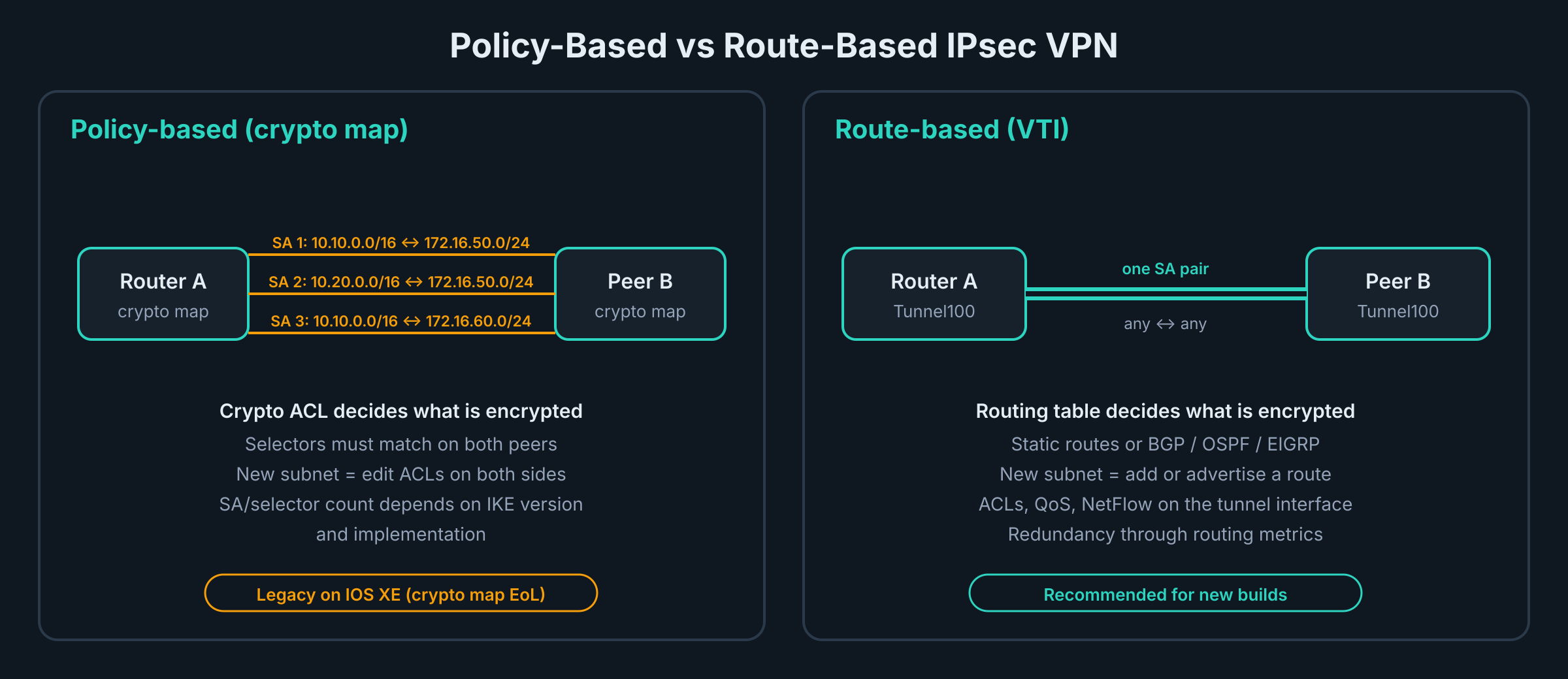
Policy-based VPN (crypto map): A crypto ACL, also called the encryption domain or proxy IDs, defines which traffic is encrypted. Traffic is protected because it matches a policy, not because a route points at a tunnel. How selectors map to IPsec SAs depends on the IKE version and the implementation. IKEv1 peers commonly negotiate a separate SA per subnet pair, while IKEv2 can carry multiple traffic selectors in one negotiation.
Route-based VPN (VTI): The tunnel is a logical interface (Tunnel on IOS XE, a VTI on FTD). Anything routed into the interface is encrypted. The traffic selector is usually any/any, and you control what crosses the tunnel with routing (static, BGP, OSPF, EIGRP) and interface ACLs.
| Attribute | Policy-based (crypto map) | Route-based (VTI) |
|---|---|---|
| What decides encryption | Crypto ACL match | Routing table |
| Dynamic routing over the tunnel | Not natively | Yes (BGP, OSPF, EIGRP) |
| Adding a new subnet | Edit the ACL on both peers; selectors must match | Add a route or advertise it in BGP |
| Redundant paths and dual ISP | Backup peers and IP SLA tracking; gets complex | Two tunnels plus routing metrics or BFD |
| Per-tunnel QoS, ACLs, NetFlow | Limited | Applied directly on the tunnel interface |
| Troubleshooting | Proxy-ID mismatches; selector and SA sprawl | Interface up/down state; usually one SA pair per tunnel |
| Where it still makes sense | Partner and third-party peers that only support policy-based | Everything else |
Crypto maps are on the way out on IOS XE. Cisco announced end-of-life dates for the IPsec static and dynamic crypto map feature in IOS XE 17.6. Use VTIs for new router builds. When a third-party peer requires policy-based, use a Multi-SA VTI (IOS XE 16.12 and later): it is a VTI on your side but negotiates per-subnet selectors with a crypto-map peer.
Platform Capabilities
| Capability | C8500 (IOS XE) | Secure Firewall 4200 (FTD) |
|---|---|---|
| Policy-based (crypto map) | Yes, but end-of-life announced | Yes (FMC policy-based topology) |
| Static VTI | Yes | Yes (FTD 6.7 and later) |
| Backup VTI | Yes (routing-driven) | Yes (FTD 7.1 and later) |
| Dynamic VTI (hub-and-spoke) | Yes (FlexVPN) | Yes (FTD 7.3 and later) |
| BGP over VTI | Yes | Yes |
| OSPF and EIGRP over VTI | Yes | Yes (FTD 7.3 and later) |
| Multi-SA VTI to policy-based peers | Yes (IOS XE 16.12 and later) | Yes (dynamic VTI with Multi-SA, FTD 7.3 and later) |
| BFD over IPsec VTI | Yes, subject to platform and release | Yes (static and dynamic VTI, FTD 10.0 and later; peer must be FTD or ASA) |
| DMVPN (mGRE + NHRP + IPsec) | Yes | No |
| GETVPN and SD-WAN overlays | Yes | No |
| NGFW inspection of tunnel traffic | Zone-based firewall; NGFW features on the newer Secure Router line | Yes (Snort 3 IPS, malware, URL filtering, TLS decryption) |
| Inter-chassis stateful IPsec failover | No | Yes (Active/Standby HA) |
DMVPN is a separate router VPN architecture, not a dynamic VTI implementation. It combines multipoint GRE, NHRP, and IPsec to build spoke-to-spoke tunnels on demand.
Routing-driven resilience isn’t exclusive to routers. With BFD on VTIs in FTD 10.0, a Secure Firewall can also use BFD and dynamic routing to fail over between tunnels.
Version check: FTD feature support depends on the release. Confirm minimum versions in the FMC configuration guide and release notes before you design around a feature.
Configuration Examples
IOS XE: Policy-Based (Legacy Crypto Map)
Shown for comparison only. Avoid this for new builds.
crypto ikev2 proposal IKEV2-PROP
 encryption aes-gcm-256
 prf sha384
 group 20
crypto ikev2 policy IKEV2-POL
 proposal IKEV2-PROP
!
crypto ikev2 keyring KR
 peer PARTNER
  address 198.51.100.10
  pre-shared-key <PSK>
!
crypto ikev2 profile IKEV2-PROF
 match identity remote address 198.51.100.10 255.255.255.255
 authentication remote pre-share
 authentication local pre-share
 keyring local KR
!
crypto ipsec transform-set TS esp-gcm 256
 mode tunnel
!
ip access-list extended CRYPTO-ACL
 permit ip 10.10.0.0 0.0.255.255 172.16.50.0 0.0.0.255
!
crypto map CMAP 10 ipsec-isakmp
 set peer 198.51.100.10
 set transform-set TS
 set ikev2-profile IKEV2-PROF
 match address CRYPTO-ACL
!
interface TenGigabitEthernet0/0/0
 crypto map CMAP
IOS XE: Route-Based (Static VTI)
crypto ipsec profile IPSEC-PROF
 set transform-set TS
 set ikev2-profile IKEV2-PROF
!
interface Tunnel100
 description VTI to 198.51.100.10
 ip address 169.254.10.1 255.255.255.252
 ip tcp adjust-mss 1360
 tunnel source TenGigabitEthernet0/0/0
 tunnel mode ipsec ipv4
 tunnel destination 198.51.100.10
 tunnel protection ipsec profile IPSEC-PROF
Then choose one way to route traffic into the tunnel.
Option A: static route
ip route 172.16.50.0 255.255.255.0 Tunnel100Option B: eBGP over the tunnel
router bgp 65001
 neighbor 169.254.10.2 remote-as 65002
 neighbor 169.254.10.2 fall-over bfd
 address-family ipv4
  neighbor 169.254.10.2 activate
Don’t configure both for the same prefix. A static route (administrative distance 1) is preferred over an eBGP route (administrative distance 20), so BGP would never be used for
172.16.50.0/24. If you want a static route as a fallback behind BGP, make it a floating static with a higher distance, such asip route 172.16.50.0 255.255.255.0 Tunnel100 250.
Secure Firewall 4200: Route-Based in FMC
- Go to Devices > Device Management > Interfaces > Add Interfaces > Virtual Tunnel Interface. Set the tunnel source (outside), a tunnel IP or borrowed IP, and assign a security zone.
- Go to Devices > VPN > Site To Site > + Site to Site VPN and choose Route Based (VTI), Point to Point, and IKEv2.
- Select the VTI as the local endpoint and define the remote peer, IKE policy, and IPsec proposal.
- Add a static route or a BGP, OSPF, or EIGRP neighbor over the VTI. OSPF and EIGRP require FTD 7.3 or later.
- Create access control rules for the VTI’s zone. Tunnel traffic is inspected and filtered like any other zone.
Tip: For partners whose equipment can’t do VTIs, FTD offers two options: a policy-based topology, or a dynamic VTI with Multi-SA (FTD 7.3 and later). Multi-SA keeps your side route-based while negotiating per-subnet SAs with the policy-based peer. For Cisco-to-Cisco and cloud tunnels (AWS, Azure, GCP, Cisco Secure Access), use route-based.
Stateful IPsec Failover
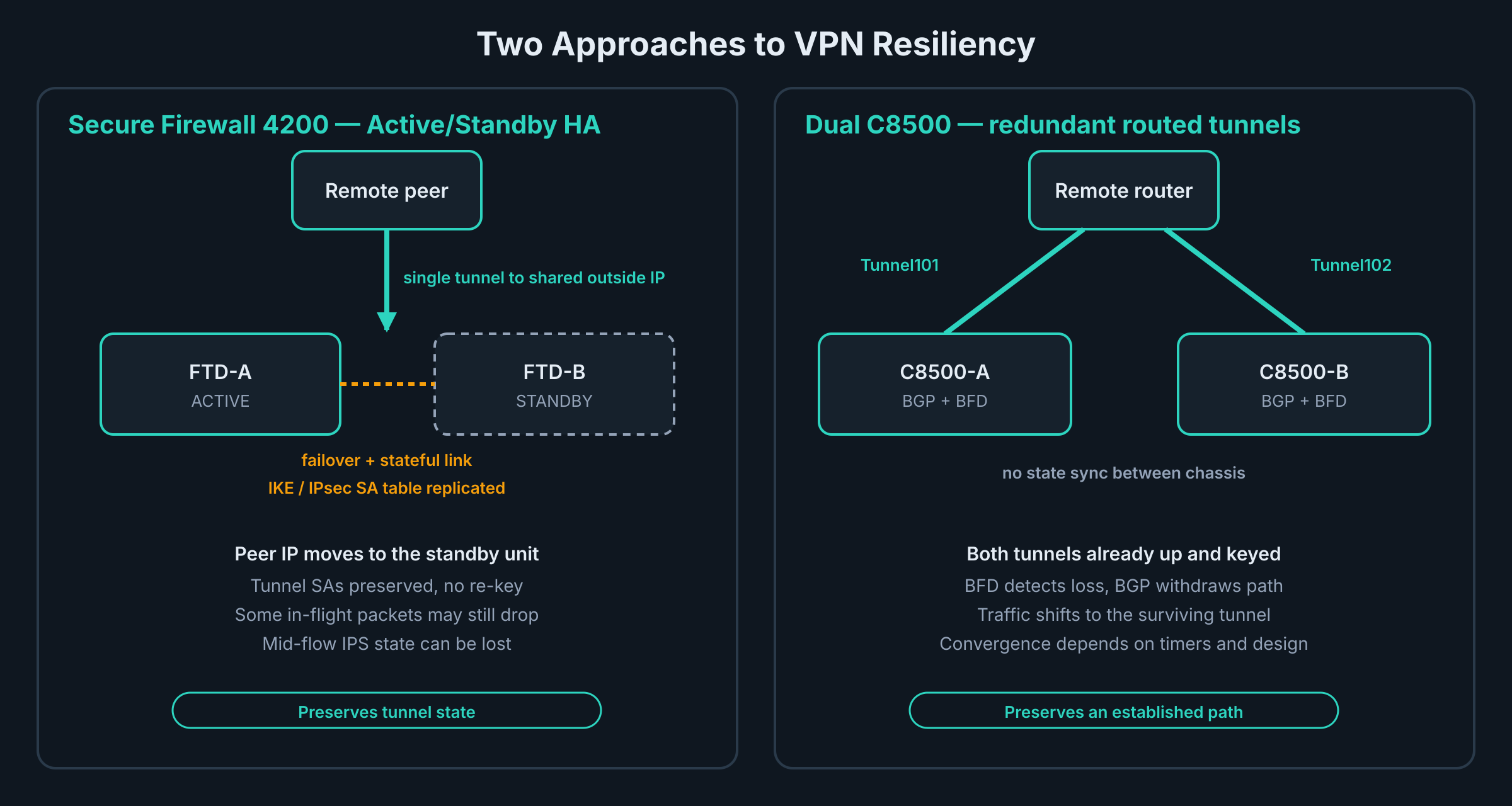
Secure Firewall 4200: Yes
In an FTD Active/Standby HA pair, the active unit continuously replicates state to the standby unit over the stateful failover link. That state includes the IKE and IPsec SA table, so site-to-site tunnels survive a failover without renegotiating. Remote access VPN users don’t need to reconnect or reauthenticate. Applications running over the VPN can still lose some packets during the switchover.
Points to plan for:
- HA requires two identical units, a failover link, and preferably a dedicated stateful link. The outside interface IP (the VPN peer address) moves to the new active unit.
- HA requires Layer 2 adjacency, so it isn’t supported for FTDv in public cloud.
- Established connections and many Snort connection states and inspection results are replicated. Some in-progress inspection state is not: intrusion-detection state for mid-flow connections, in-progress file identification, and pending DNS-based Security Intelligence decisions can be lost.
- Dynamic routes learned over VTIs may need to reconverge after failover. Tune graceful restart or BFD timers so a failover doesn’t flap routing unnecessarily.
Secure Firewall 4200 Clustering
Clustering is a different design from HA, with different VPN behavior:
| Mode | Behavior | Requirements and limitations |
|---|---|---|
| Centralized (default) | Only the control node terminates site-to-site VPN | VPN does not take advantage of cluster high availability. Remote access VPN is not supported with clustering. |
Distributed (cluster vpn-mode distributed) |
Site-to-site IKEv2 sessions are spread across cluster nodes | Secure Firewall 4200 requires FMC and FTD 10.0 or later. Also requires Spanned EtherChannel mode, routed mode, a Carrier license on each cluster member, and IKEv2 only. No inter-site clustering. |
VTIs and clustering: Cisco lists Virtual Tunnel Interfaces (static and dynamic) among the features that can’t be configured with clustering enabled. A cluster’s site-to-site VPN is therefore policy-based. If your design depends on route-based VTIs, use an HA pair, and check the clustering guide for your exact FTD release.
C8500 (IOS XE): No Inter-Chassis Stateful IPsec
Classic IOS had a feature called Stateful Failover for IPsec, which used HSRP and inter-box SSO to synchronize SAs between two routers. It was crypto-map-based and is not supported on IOS XE platforms. Cisco also documents that IPsec stateful failover is not supported with VTIs.
IOS XE does have two features that are often confused with it:
- IPsec VPN High Availability Enhancements (HSRP with
crypto map ... redundancy, or a VTI sourced from the HSRP virtual IP). This is stateless. HSRP doesn’t transfer IPsec state between routers, so on failover the SAs are torn down and IKE/IPsec renegotiates on the new active router. Enable DPD or IKE keepalives so the remote peer detects the change quickly. - Intra-chassis software redundancy (two IOSd processes with SSO on one router). This protects against an IOS process failure inside one router, not against losing the chassis, its power, or its uplinks.
Avoid HSRP-fronted VPN designs on routers. Failover still means renegotiating every tunnel, which can take time with hundreds of peers. Redundant routed tunnels are usually faster and simpler.
Router Resilience: Redundant Routed Tunnels
With route-based VPNs, you build two independent tunnels, one to each headend router, and let routing select the path. BFD must be enabled on each tunnel interface, either with a template or with interface-level timers, and the BGP neighbors must reference BFD.
! Remote side: two tunnels, one per C8500 headend
bfd-template single-hop BFD-VPN
 interval min-tx 300 min-rx 300 multiplier 3
!
interface Tunnel101
 description To DC-RTR-A
 ip address 169.254.101.2 255.255.255.252
 tunnel source TenGigabitEthernet0/0/0
 tunnel mode ipsec ipv4
 tunnel destination 203.0.113.1
 tunnel protection ipsec profile IPSEC-PROF
 bfd template BFD-VPN
!
interface Tunnel102
 description To DC-RTR-B
 ip address 169.254.102.2 255.255.255.252
 tunnel source TenGigabitEthernet0/0/0
 tunnel mode ipsec ipv4
 tunnel destination 203.0.113.2
 tunnel protection ipsec profile IPSEC-PROF
 bfd template BFD-VPN
!
router bgp 65010
 neighbor 169.254.101.1 remote-as 65001
 neighbor 169.254.101.1 fall-over bfd
 neighbor 169.254.102.1 remote-as 65001
 neighbor 169.254.102.1 fall-over bfd
 address-family ipv4
  neighbor 169.254.101.1 activate
  neighbor 169.254.102.1 activate
  ! Active/active only: install both paths (ECMP)
  maximum-paths 2
Both tunnels stay up and keyed all the time. For active/standby, prefer one path with local preference or AS-path prepending. For active/active, BGP doesn’t install both paths just because two neighbors are up. Add maximum-paths 2, and make sure the paths meet BGP multipath requirements (same AS path length, attributes, and so on).
The example reuses one IPsec profile for both tunnels. In that case, the IKEv2 profile, keyring, and identity matching must accept both headends (203.0.113.1 and 203.0.113.2), or you need a separate IKEv2 profile per headend.
With 300 ms × 3, BFD’s nominal detection time is about 900 ms. End-to-end convergence also depends on BGP processing, FIB updates, the remote side’s configuration, and whether the failure is detected locally or only through BFD. Treat sub-second detection as a design target, not a guaranteed failover time. Configure matching BFD timers on the headend routers too.
This design mirrors the redundant tunnel architecture used by AWS Site-to-Site VPN, Azure active-active VPN gateways, and Google Cloud HA VPN. It scales to many peers without state synchronization.
Failure Scenarios Compared
Device redundancy, path redundancy, and geographic redundancy are separate design goals. The two approaches handle each one differently:
| Failure scenario | FTD Active/Standby HA | Dual routers with VTIs |
|---|---|---|
| Active device failure | Stateful chassis failover | Routing convergence to the surviving tunnel |
| ISP circuit failure | Depends on interface monitoring and WAN design | Alternate tunnel selection, if headends are independently connected |
| Remote tunnel failure | DPD, routing, or backup VTI | BFD and routing convergence |
| Data center failure | Depends on the HA topology | Alternate headend, if geographically distributed |
| VPN SA synchronization | Yes | No |
| Active/active forwarding | Not between HA members | Supported with ECMP |
| Geographically diverse headends | Constrained by HA Layer 2 requirements | Native design capability |
| IPsec renegotiation after local chassis failure | Normally not required | Not required on the surviving, already-established tunnel |
Failover bottom line: An FTD Active/Standby HA pair can preserve IKE/IPsec security-association state during a chassis failover. A dual-C8500 design instead maintains independent, established VPN tunnels and uses routing convergence to redirect traffic when a path fails. Both provide resiliency, but they work differently, and neither guarantees uninterrupted application traffic.
Router or Firewall? Common Architectural Patterns
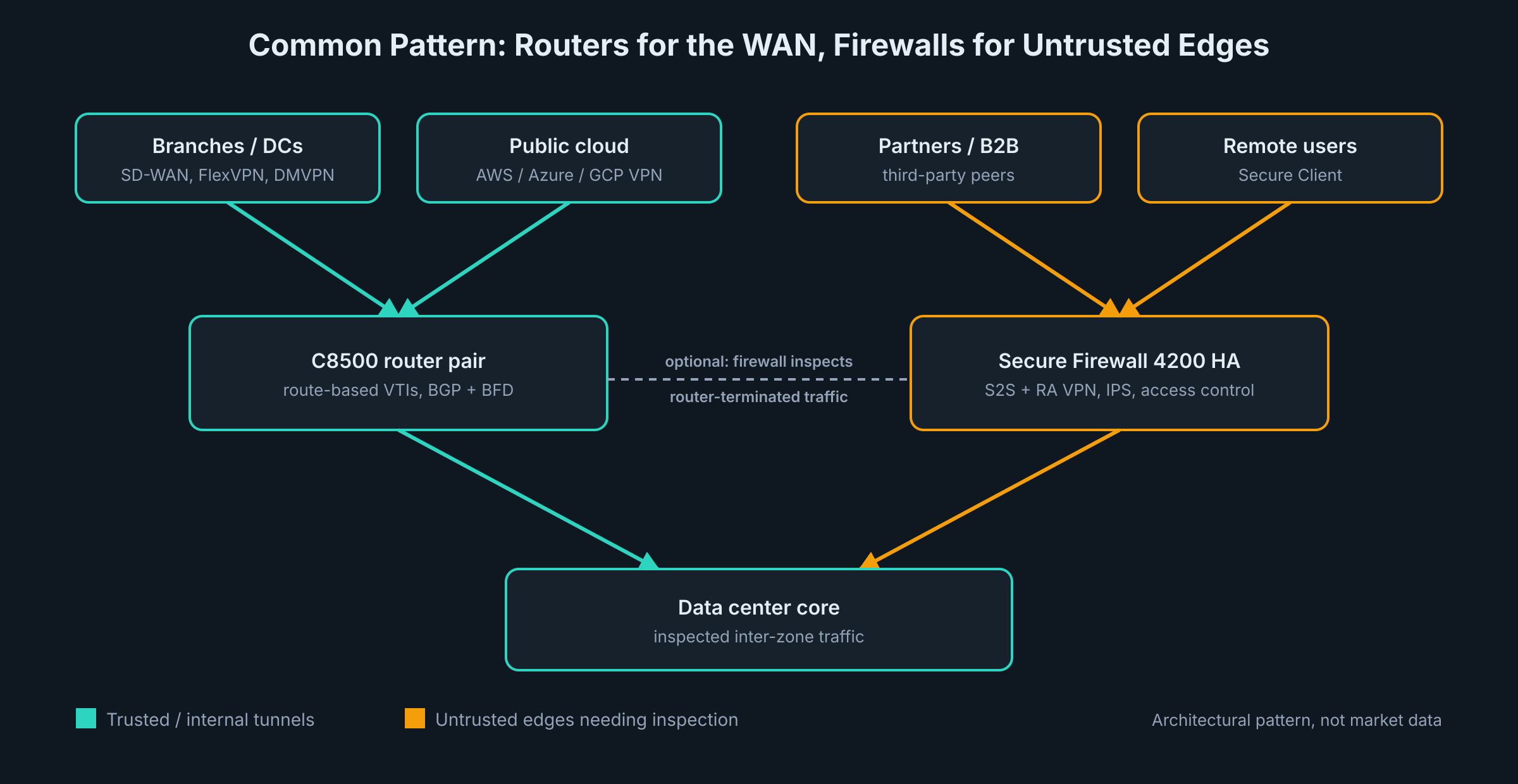
No public market data tracks which device type terminates enterprise site-to-site VPNs, so this section describes architectural patterns, not an established industry migration. The patterns below are common in Cisco environments:
- Route-based is the default for new builds. Policy-based mostly survives for third-party and partner tunnels where the far end can’t or won’t do VTIs. On IOS XE, the crypto map end-of-life makes this direction explicit.
- Routers often carry WAN-scale tunnels. Branch-to-DC, DC-to-DC, and DC-to-cloud tunnels at scale frequently run on routers, as SD-WAN overlays, DMVPN, or FlexVPN. Routing, ECMP, QoS, and high tunnel counts are router strengths, and Cisco positions the 8500 Secure Router for high-scale IPsec aggregation in the data center.
- Firewalls often hold the untrusted edges. Remote access VPN, partner extranets, and tunnels to peers that aren’t fully trusted commonly stay on the Secure Firewall, where IPS, access control, logging, and stateful HA apply.
- Many designs use both. Routers terminate internal and cloud tunnels, and a Secure Firewall inspects traffic between zones behind them.
Are Organizations Moving Away from the Secure Firewall for Routers?
There’s no data showing a broad migration. What’s visible is product direction and architecture:
- SD-WAN and SASE increasingly handle branch-to-branch and branch-to-cloud connectivity, with security delivered at the edge or in the cloud rather than by sending all traffic through a data center firewall.
- Security on the router: Cisco’s 2025 Secure Router lineup (8100 through 8500) combines L7 firewalling, faster IPsec, and SD-WAN in the router. Industry analysts describe this as routing-focused teams getting firewalling that is sufficient for many sites, while Secure Firewall remains the platform for teams that need full threat protection.
- Operational fit: Network teams often prefer BGP-driven tunnel failover they already operate over firewall HA pairs that require Layer 2 adjacency and identical hardware.
For many site-to-site WAN designs, the router is a strong fit. For remote access VPN, partner and B2B tunnels, and inspected inter-zone traffic, the Secure Firewall remains the natural termination point. The choice depends on trust boundaries, scale, and which team operates the device.
Decision Guide
| Requirement | Recommended platform and design |
|---|---|
| Hundreds of branch, DC, or cloud tunnels with dynamic routing | C8500 with static VTIs, FlexVPN, DMVPN, or Cisco Catalyst SD-WAN, depending on architecture and scale |
| A tunnel that must survive a chassis failure without re-keying | Secure Firewall 4200 Active/Standby HA pair |
| Fast failover across many peers | Two C8500 routers, dual tunnels, BGP with BFD |
| Partner or third-party tunnels you don’t fully trust | Secure Firewall 4200 (policy- or route-based) with access control and IPS on the tunnel zone |
| Remote access VPN | Secure Firewall 4200 HA pair (not supported on clusters) |
| A peer that only supports policy-based | Multi-SA VTI on the router (IOS XE 16.12 and later) or on FTD (dynamic VTI with Multi-SA, 7.3 and later), or an FTD policy-based topology |
| Site-to-site scale beyond a single firewall | Secure Firewall 4200 cluster in distributed VPN mode (FTD 10.0 and later, IKEv2, Carrier license, no VTIs) |
| DMVPN, GETVPN, or SD-WAN overlays | C8500 (FTD doesn’t support these) |
Verify before you build: Feature support changes between releases and hardware generations. Check Cisco Feature Navigator and the release notes for your exact IOS XE and FTD versions, especially for Multi-SA VTI, dynamic VTI, distributed cluster VPN, and HA limitations.
Key Takeaways
- Use route-based VPNs on both platforms unless a peer requires policy-based.
- The Secure Firewall 4200 supports stateful IPsec failover through Active/Standby HA with IKE/IPsec SA replication.
- C8500 routers don’t synchronize IPsec state between chassis. Build two tunnels, bind BFD to each tunnel interface, and let BGP handle failover.
- Neither design guarantees zero packet loss. They solve resiliency differently.
- Choose the termination point by trust boundary and scale: routers commonly handle internal WAN tunnels, and firewalls commonly handle untrusted edges.