The setup: two ISPs and one IX port
The edge has three external connections, and all three can carry traffic:
- Lumen: transit to the whole internet, billed by bandwidth.
- Cogent: transit to the whole internet, used as backup.
- Equinix Internet Exchange (IX): one port onto a shared switch fabric that other participating networks connect to.
The third one is where the confusion starts. Equinix runs the exchange, and many networks connect to it: CDNs, cloud providers, SaaS companies and ISPs. Any of them that peer with you can send packets straight to your router across that switch. So the IX port is a real data path, not a monitoring link.
Route servers and route collectors carry routes, not traffic
The instinct that these peers “just handle data” is half right. Neither forwards a single packet of yours, but they do very different jobs.
| Route servers | Route collector | |
|---|---|---|
| What it does | Distributes eligible routes to participating peers, subject to export policy and filtering | Receives your routes and sends nothing back |
| Why you peer with it | One BGP session per route server instead of hundreds of bilateral sessions | Equinix uses it for its looking glass, troubleshooting and statistics |
| Effect on your traffic | Can enable direct routing between participants; each peer applies its own routing policy | None |
| In the data path? | No | No |
The key detail is that route servers normally preserve the advertising peer as the BGP next hop. When a route server advertises a CDN prefix to you, the BGP NEXT_HOP normally remains the CDN router’s address on the IX peering LAN, not the route server’s address. Packets go straight from your router to the CDN’s router across the switch. The route server only made the introduction.
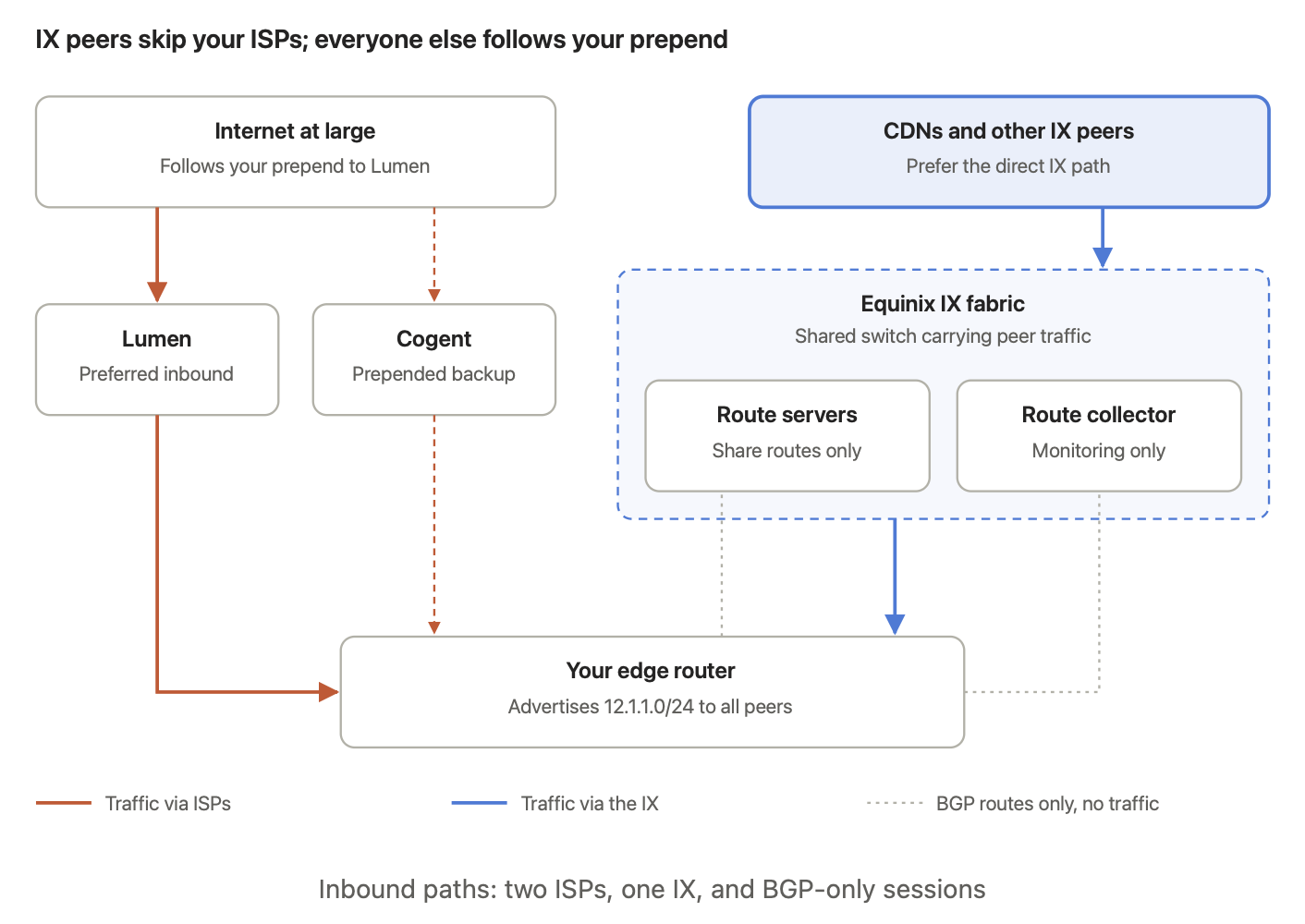
Solid orange and blue lines show possible inbound traffic paths; dashed orange shows a less-preferred but available transit path. Gray dotted lines show BGP-only relationships, not packet forwarding. Eligible IX peers may use the direct path, while other networks choose between Lumen and Cogent according to their own BGP policy.
You control outbound. You only influence inbound.
This is the part that trips up experienced engineers. Say you advertise the documentation prefix 203.0.113.0/24 to Lumen and to Cogent, with a prepend on Cogent. Most of the internet now sees two paths:
- Via Lumen:
Lumen your-AS - Via Cogent:
Cogent your-AS your-AS your-AS
Where AS-path length is the tiebreaker, networks pick Lumen. Your prepend works, and it feels like control. It isn’t.
Prepending is a hint, not a command. Every network runs its own best-path selection, and local preference, which each network sets by its own policy, is compared before AS-path length. Providers commonly prefer customer routes over peer routes, and peer routes over transit. Some also cap or filter long prepends, or apply traffic engineering of their own. A prepend can shift some inbound traffic, but the result depends on the policies of other networks and must be measured.
But you also advertise 203.0.113.0/24 to the Equinix route servers. Eligible IX participants may learn a third path that can reach you without traversing either transit ISP:
- Direct over the IX:
your-AS
A CDN that receives and accepts this route may select the direct IX path. Its local-preference policy can make peering more attractive than transit, even when AS-path lengths differ. You cannot force that selection from your edge: the remote network controls its own best-path decision.
The CDN is choosing its own inbound path to your prefixes; it is not overriding routing decisions for the rest of the internet. Other IX participants independently decide whether to use their IX-learned routes.
The same local-pref logic explains a second surprise: Cogent’s own customers will probably still reach you through Cogent. Cogent learns your route directly from you as a customer and prefers it, prepend or not. Prepending steers most of the internet, not all of it.
Outbound routing is primarily controlled by your own BGP policy. Local preference is one common tool, but best-path decisions also depend on which routes are accepted, next-hop reachability, and other BGP attributes. Without an explicit policy, you should inspect the selected routes rather than assume shorter AS paths will always send traffic across the IX.
What actually comes in over the IX
An arbitrary internet client does not automatically reach you over the IX. Direct IX traffic can include the following, depending on each network’s routing policy.
Return traffic for your own users. An employee downloads an OS update or opens a SaaS app. Much of that content is delivered by CDN servers. The request leaves through the path selected by your routing policy. The response follows the CDN’s routing policy toward your public source or NAT address. If the CDN has accepted your IX advertisement and selected it, the response may return over the IX. For many companies, this is a big share of what would otherwise fill the Lumen circuit.
A CDN in front of your public services. If your websites sit behind a CDN or WAF that peers at the exchange, clients connect to the provider’s edge, not to you. The provider then fetches content from your origin servers. If the CDN’s origin-facing infrastructure has reachability through your IX peering and prefers that path, origin traffic may use the IX instead of transit. This is not guaranteed simply because the CDN and your network are connected to the same exchange.
That’s the business case. Many IX peering relationships are settlement-free, although port, cross-connect, and other connectivity fees still apply. You get fewer hops to the networks your users rely on, capacity freed on your transit circuits, and a third path to many important destinations.
If you’d rather keep everything on Lumen and Cogent, you have options. You can stop advertising to the route servers, or use Equinix’s route-server BGP communities to limit which peers receive your routes. Just know that you’re giving up most of what the IX port is for.
The ping test that proves nothing
Here’s a real scenario. An engineer opens a ticket with Equinix: “packet loss on one of the route server paths.” His evidence is a continuous ping to the route server’s BGP peer IP, a public address, run from a remote site over the internet.
That test fails on three counts.
- It doesn’t test your path. The ping leaves the remote site’s internet connection and crosses other networks before it reaches the IX peering LAN. It may never touch your edge router or your IX port. Loss anywhere along that route shows up as “loss to the route server.”
- ICMP to infrastructure can be rate-limited. Routers and route-server hosts may limit ICMP packets addressed to their own control planes. That does not mean all transit ICMP packets are deprioritized, and ICMP loss alone does not prove that production forwarding is impaired.
- The address may not be meant to be reachable. Equinix numbers its IX peering LANs from public address space, which is why the IP looks public. Those subnets normally aren’t announced to the internet. Reachability from a remote location depends on the exchange’s addressing and routing arrangements; never assume a public-looking peering address is globally reachable.
There is a deeper distinction: traffic between IX peers does not transit the route server. However, route-server failures, withdrawals, filtering mistakes, or incorrect route attributes can change forwarding decisions even when the BGP session remains established.
How to troubleshoot an IX connection properly
Start IX-specific testing from the edge router, sourced from the IX interface, and correlate it with production-flow evidence. From there, the route server’s subnet is directly connected, so the ping crosses only your port, the cross-connect and the Equinix switch.
- Confirm the path. Run
show ip route <RS-IP>. It should show as directly connected through the IX interface. - Check the BGP sessions. Look at uptime, flaps and hold-timer expiries on both route-server sessions. A stable session confirms adjacency, not that the expected prefixes are being learned, accepted, or installed.
- Check the IX interface. Look for input errors, CRC errors and drops, and check light levels on the optic.
- Ping other peers’ IX IPs. Correlated loss to several peers can justify investigating your port, cross-connect, and IX fabric, but verify that peers respond reliably to ICMP. Loss to one peer may reflect its ICMP policy or a peer-specific issue.
- Compare RS1 and RS2. Different ICMP results do not alone establish a fabric fault or prove rate limiting; compare BGP state, route changes, interface counters, and actual forwarding behavior.
- Ask Equinix the right question. Ask them to check your port and cross-connect statistics, and whether the route server rate-limits ICMP. “We see ping loss” alone won’t get a useful answer.
A clean interface and stable BGP sessions are encouraging, but not a complete health check. Verify expected routes, next-hop resolution, forwarding counters, congestion or drops, and affected application flows before closing the investigation.
The short version
- An IX port is a real data path. Route servers and route collectors are not.
- Route servers distribute eligible routes subject to policy; participating networks make their own BGP decisions. A route collector receives routing information for visibility.
- Advertising to route servers makes eligible IX reachability available; it does not guarantee that every participant receives or chooses the route. Prepending on your ISPs doesn’t change that, and even between your ISPs, a prepend is a hint, not a guarantee.
- IX traffic often includes CDN and cloud traffic, but its composition depends on your peers and applications. Keeping it off paid transit is the point.
- Troubleshoot from your own IX-facing router and validate production forwarding; remote pings to route-server addresses are not a reliable IX health test.